Loading...
Custom Labels · Blank Labels · Your Brand. Our Priority.
Loading...
Labels and Media
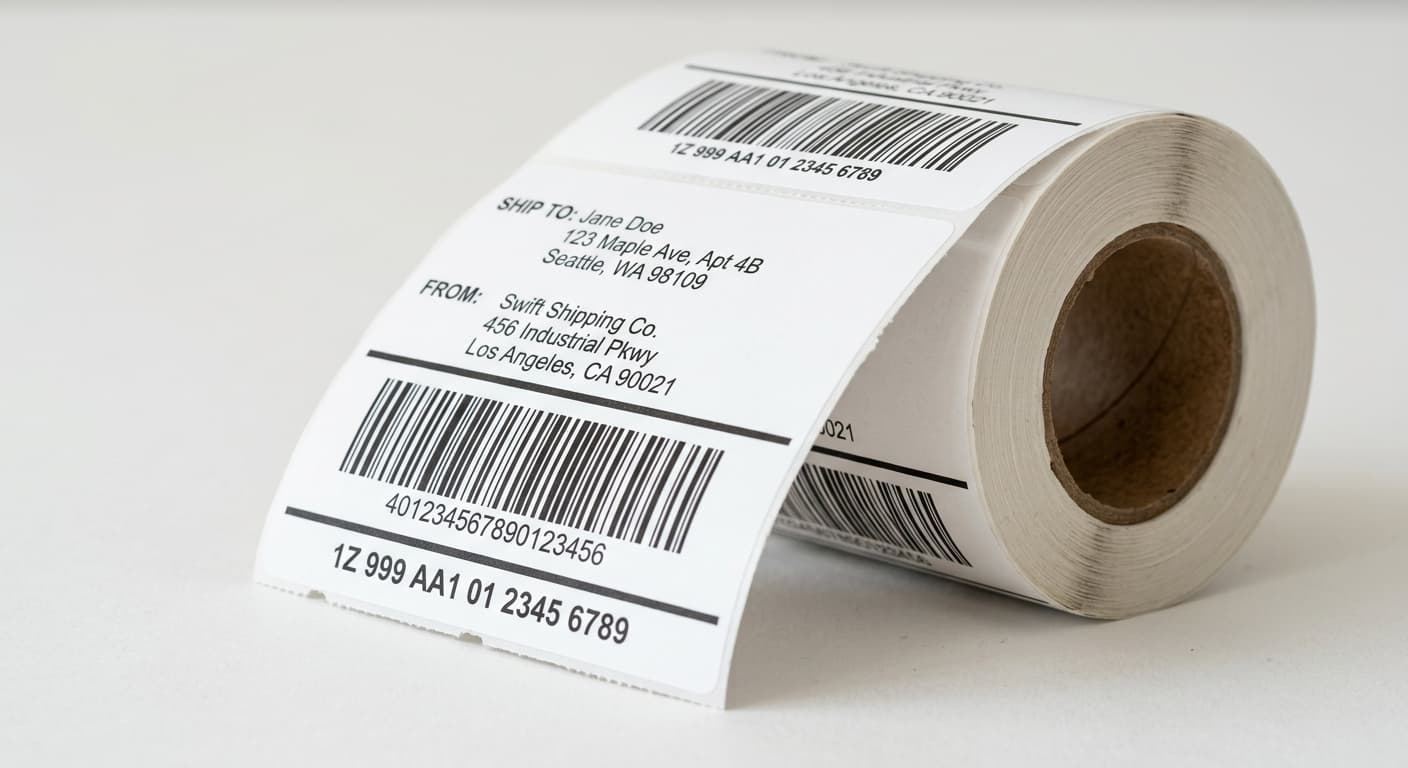
Label size is written as width by height, in inches, with width listed first. A 4 x 6 label is 4 inches wide and 6 inches tall as it feeds through the printer. Getting the order right matters because every printer has a maximum print width, and that width is measured across the label as it travels through the machine, not along its length.
On a 4 inch printer, the maximum print width is close to 4.09 inches, so any label wider than that will not fit no matter how the roll is wound. The carrier, the liner the labels are stuck to, also has its own width, and it needs to sit inside the printer guides without binding or wandering side to side as the roll feeds. If a label is rotated 90 degrees compared to how the roll was manufactured, the width and height in your design file can end up swapped from what actually prints, so always confirm orientation against a physical sample before ordering a full case.
Most everyday labeling needs are covered by a small handful of standard sizes. Here is what each one is typically used for in practice.
The core is the cardboard tube at the center of the roll, measured by its inside diameter. Desktop label printers, the kind that sit on a counter or shipping station, are built around a 1 inch core, and the rolls that fit them run roughly 4 to 5 inches in outside diameter. Industrial printers use a larger 3 inch core and can accept rolls up to about 8 inches in outside diameter.
The two are not interchangeable. An 8 inch roll on a 3 inch core will not fit into the media compartment of a desktop printer, since that compartment simply is not built to hold a roll that large. Always check core size and maximum outside diameter against your printer specification before ordering, not just the label size itself.
Roll diameter also decides how many labels come on a roll, and how many rolls come in a case. A small 4 inch outside diameter roll on a 1 inch core might hold a few hundred labels, while an 8 inch roll on a 3 inch core can hold several thousand of the same size label. A bigger roll means fewer roll changes during a shift, which matters most on a line running labels continuously. For lower volume desktop use, the smaller roll is usually the more practical fit since it takes up less storage space and matches how often the printer actually runs.
Label face stock is prepared for one of two print methods. Direct thermal stock has a heat sensitive coating built into the paper itself, so it darkens directly under the printhead with no ribbon involved. Thermal transfer stock has no such coating and relies on a ribbon to melt an image onto its surface. Which one fits your labels depends mostly on how long the print needs to stay legible, a decision covered in full in our printer buying guide, but the short version is that direct thermal suits short lived labels and thermal transfer suits anything that needs to last.
Paper face stock comes either topcoated or non-topcoated. A topcoat is a thin protective layer over the paper that resists smudging and light moisture, and it is the standard choice for most shipping and product labels since it holds up through normal handling. Non-topcoated paper is slightly less expensive and works fine for short lived, indoor labels such as pick tickets and internal tote labels that are read once and discarded.
Adhesive falls into two main categories, permanent and removable. Permanent adhesive is meant to stay put for the life of the product, so it is the right choice for shipping labels, compliance labels, and anything that should not come loose or be peeled off without damaging the surface underneath. Removable adhesive is built to come off cleanly, without residue, which makes it the right call for price tags that change seasonally, temporary promotional labels, or any label applied to a surface that will be reused. Choosing removable adhesive for a label that needs to stay put, or permanent adhesive for one that needs to come off cleanly later, is one of the more common ordering mistakes we see.
Perforation is the light cut, or perf, between one label and the next on a roll, and it lets a printed label tear away cleanly by hand when a printer is not doing the cutting. Most rolls are perforated between labels even when the printer will not use that perf directly. Timing marks and gap sensing are how the printer itself knows where one label ends and the next begins. Gap sensing works by shining light through the liner and detecting the small gap between labels, which works well for most standard die cut labels. Timing marks are a printed black bar on the back of continuous or non-standard media that the printer sensor reads instead of a gap.
The sensing method built into your printer, gap, black mark, or continuous, has to match how the roll is made, otherwise the printer will misfeed, print across two labels, or stop thinking it has run out of media. If a roll is not printing in registration after a media change, checking that the sensor type matches the new roll is the first thing to look at.
Beyond plain white paper, a handful of specialty stocks solve specific problems. Pastel colored labels, in shades such as yellow, green, pink, and blue, are commonly used for zone coding or priority marking on cartons and totes, so a team can sort at a glance without reading the label text closely. Freezer and cold chain adhesive is formulated to stay stuck on cold, sometimes condensing, surfaces where a standard adhesive would let go within days. Synthetic face stock, made from polypropylene or polyester film rather than paper, resists water, chemicals, and outdoor exposure far better than paper, which makes it the right choice for labels going on chemical containers, outdoor equipment, or anything that will get wet or handled roughly over its life.
With more than 25 years of experience and authorized GoDEX reseller status, our team can help you match the right printer, label stock and ribbon to your operation.