Loading...
Custom Labels · Blank Labels · Your Brand. Our Priority.
Loading...
Labels and Media
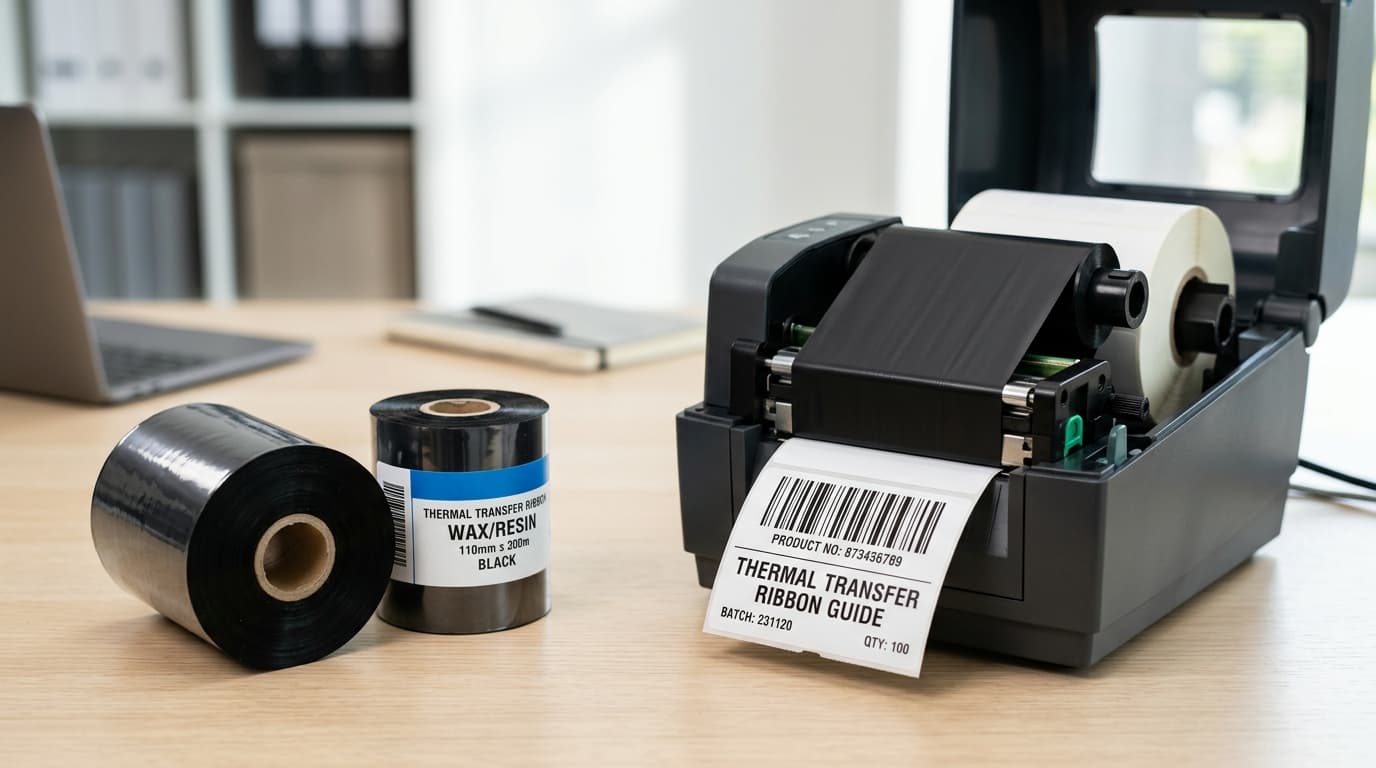
Thermal transfer printing works by melting a thin coating off a ribbon and onto a label. That coating, the ribbon chemistry, is what actually determines how long the printed image survives contact with heat, moisture, chemicals, and abrasion. Two labels can look identical the day they are printed and behave completely differently six months later, purely because of which ribbon grade produced them.
Choosing the wrong ribbon is one of the most common and most avoidable mistakes in a labeling program. It usually shows up as smeared text, faded barcodes that stop scanning, or print that wipes off with a gloved hand, all problems that a different ribbon grade would have prevented from day one.
The good news is that ribbon chemistry only comes in three practical grades, and each one is built for a clearly defined level of durability. Once you understand what wax, wax-resin, and resin actually do differently at the molecular level, matching a ribbon to a job becomes a quick, repeatable decision rather than a guessing game every time you reorder.
Wax ribbons are the most common and least expensive thermal transfer ribbon type. They print cleanly on standard coated paper labels and produce the sharp, high-contrast barcodes needed for shipping labels, price tags, and general warehouse labeling. Wax coatings melt at a relatively low temperature, which also means printers can run them at higher speeds with less printhead wear.
The tradeoff is durability. Wax print is soft and can smear if scratched, gets damaged by exposure to grease or solvents, and will not hold up well outdoors or in wet conditions. Wax ribbons are the right choice when the label lives a short, controlled indoor life, such as a shipping label, a pick ticket, or an internal inventory label that will not be handled roughly.
Wax-resin ribbons blend wax with a percentage of resin to add meaningful resistance to smearing, light chemical exposure, and scratching, while still printing at reasonable speed on a wider range of label stocks, including semi-gloss coated paper and some synthetic materials. This makes wax-resin the middle ground: more durable than pure wax, less expensive and slightly faster-printing than pure resin.
Wax-resin is a strong default choice for product labels that get handled during shipping and storage, drum and container labels in light industrial settings, and any label that needs to survive incidental contact with oil, grease, or moisture without full outdoor exposure. It is the ribbon we recommend most often when a customer is unsure which grade to choose and the labels are going on synthetic (polypropylene or polyester) stock.
Full resin ribbons are built for the harshest conditions a label will realistically face: sustained heat, direct chemical or solvent contact, outdoor UV exposure, and heavy abrasion. Resin coatings bond more aggressively into synthetic label materials such as polyester and polypropylene, and the resulting print resists fading and scratching far longer than wax or wax-resin alternatives.
Resin ribbons cost more per roll and generally require slightly slower print speeds to achieve full transfer quality, but that cost is easily justified for compliance labels, outdoor asset tags, electrical component marking, and any label that must remain fully legible for years, sometimes in direct sunlight or exposed to solvents and cleaning chemicals. If a label failure would mean a compliance issue or a mislabeled asset in the field, resin is the safer investment.
Ribbon chemistry has to be matched not just to the environment the label will face, but to the label material itself. Coated paper labels work well with all three ribbon types, so the choice there comes down entirely to durability needs. Synthetic label stocks, such as polypropylene and polyester, behave differently: wax ribbons often do not bond well to synthetic film and can produce a dull, low-contrast print or one that scratches off easily, while wax-resin and resin formulations are specifically engineered to bond properly with these materials.
As a practical rule, if you are printing on a synthetic (film) label rather than a paper label, skip pure wax and move directly to wax-resin or resin depending on how demanding the environment is. If you are not sure what your label facestock is made of, check with your label supplier or send us a sample; the wrong ribbon-to-material pairing is one of the fastest ways to waste ribbon and produce unreliable barcodes.
Ribbon width and length need to match both the printer and the label width being printed. A common industrial ribbon size is 110mm wide by 300 meters long, sized to run on 4-inch print-width printers and to last through a large batch of labels before a changeover is needed. Running a ribbon that is narrower than your label leaves parts of the label unprinted, while a ribbon that is too short relative to your label roll means more frequent changeovers than necessary.
Always match the ribbon width as closely as possible to your label width (slightly wider is fine, narrower is not) and choose a ribbon length that reasonably matches your label roll length so ribbon and label run out at close to the same time. This reduces both waste and the number of times an operator has to stop the line to reload consumables. A 110mm by 300m ribbon is a good general-purpose reference size for 4-inch printers running mid-length label rolls, though your printer manufacturer will list the exact maximum ribbon length its ribbon spindle supports.
With more than 25 years of experience and authorized GoDEX reseller status, our team can help you match the right printer, label stock and ribbon to your operation.